How Do You Know if You Have Lipedema

Getting an initial diagnosis for Lipedema is typically time-consuming, challenging, and emotionally draining. Why? Because the misdiagnosis starts from a very early historic period and comes from those closest to united states of america, and even from the patient themselves. Those of us suffering from Lipedema normally hear phrases like, "You're just big-boned," or, "Y'all have a pear shape, it's just your body."
Family unit members are quick to advise that larger bodies or a specific body shape run in the family, and there'southward not much nosotros tin can practise about information technology. While the assertion is harmless, it may not be the full truth. And while it'due south normal for many women to accrue fat in their thighs, hips, and buttocks, when is it beyond the normal range? When is it more than just "curvy"?
The typical explanations we hear in adolescence accelerate in adulthood. Afterwards years of trying every diet and exercise routine under the dominicus, many seek medical advice in the hopes of an caption. This time, the common phrases range from "Maybe you need to command your ambition and portion sizes," to, "I know you say you're working out and have a counterbalanced diet, simply the scale says otherwise." By the time we learn virtually Lipedema and make our way a specialist, we've been dismissed by other professionals, exhausted by our endless efforts, and worn down by the journey.
The question that ultimately leads u.s. to a Lipedema diagnosis is a simple one that we are asking from childhood; "My legs wait fat – Is that normal?" The mainstream answers and usually accustomed explanations are what lead us to constant frustration. If calories we take into our body equal calories we burn off, we "shouldn't" exist gaining weight, right? If the calories we accept into our body are fewer than the calories we are called-for, we should lose weight. Right? If this equation rings true, and then why are my legs so different?
Weight Distribution
To reply this question, nosotros must beginning ask several more than. Commencement, let'southward evaluate how our legs may physically wait unlike than other overweight body types. Practice you tend to gain weight around the "torso" of your torso? For example, if you fold your body in half at the hips, would your bottom half be significantly larger and out of proportion with the top half? Information technology's common for women with Lipedema to written report vastly different vesture sizes between their upper and lower bodies, such as wearing a size M or L shirt, but a size XXL in pants. For me, I've always had an extremely  slim waist, then much then that my swimsuit tops were an extra small, and my bottoms were an Xl. As much as I wanted to wear a i-piece to embrace up as much as possible, at that place simply was not a size that existed to fit my farthermost pear-shaped trunk. The shape of your legs and how you lot bear weight is also telling. Do your legs appear thick and column-similar, without much definition or shape effectually the knees? This was a key feature of my body that ultimately led to my personal discovery of Lipedema.
Adjacent, evaluate the effects of your weight gain on your ankles and feet. Exercise your anxiety appear to gain weight like to the rest of your legs? Or, does the weight gain stop at the ankle, and your feet remain relatively "normal" in size? This may cause a cuff-like event around the ankle as if yous had a rope tightened around the lesser of your legs. If you're like me, you might non be able to wear certain types of boots or shoes, because they either accentuate your cankles or they aren't able to fit over your calves.
WithLipedema fatty, we experience fat accumulation in specific areas, which may assistance indicate if your weight gain is normal or non. If yous're gaining pockets of fat that are out of proportion to other areas, this may exist a tip-off that yous accept Lipedema. This can be difficult to take hold of considering patients are often in the 3rd stage of Lipedema when it becomes clear that the gains are irregular across the body.
Other areas of the body that tin can help determine if your weight gain may be due to Lipedema:
- Cankles: fat accumulation around the back of your ankles, causing an "talocrural joint cuff." This type of weight proceeds is a clinical sign just seen in Lipedema. Not all patients become this, but if you accept it, it may be an indicator
- Bat Wings: Weight gain in your upper arms, causing a "bat win" effect. This is seen in about 80% of women with Lipedema.
- Saddle Bags: Big areas of fat that projection outwardly beyond the normal curve of your hip, also known every bit "football game saddlebags" (because they await like there'southward a football on the sides of your hips).
- Buttock Self: This is a larger buttock that sticks out significantly from the lower back when looking at your silhouette from the side. This is another feature seen in most women with Lipedema.
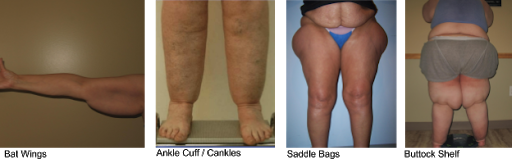
Hurting & Mobility Problems
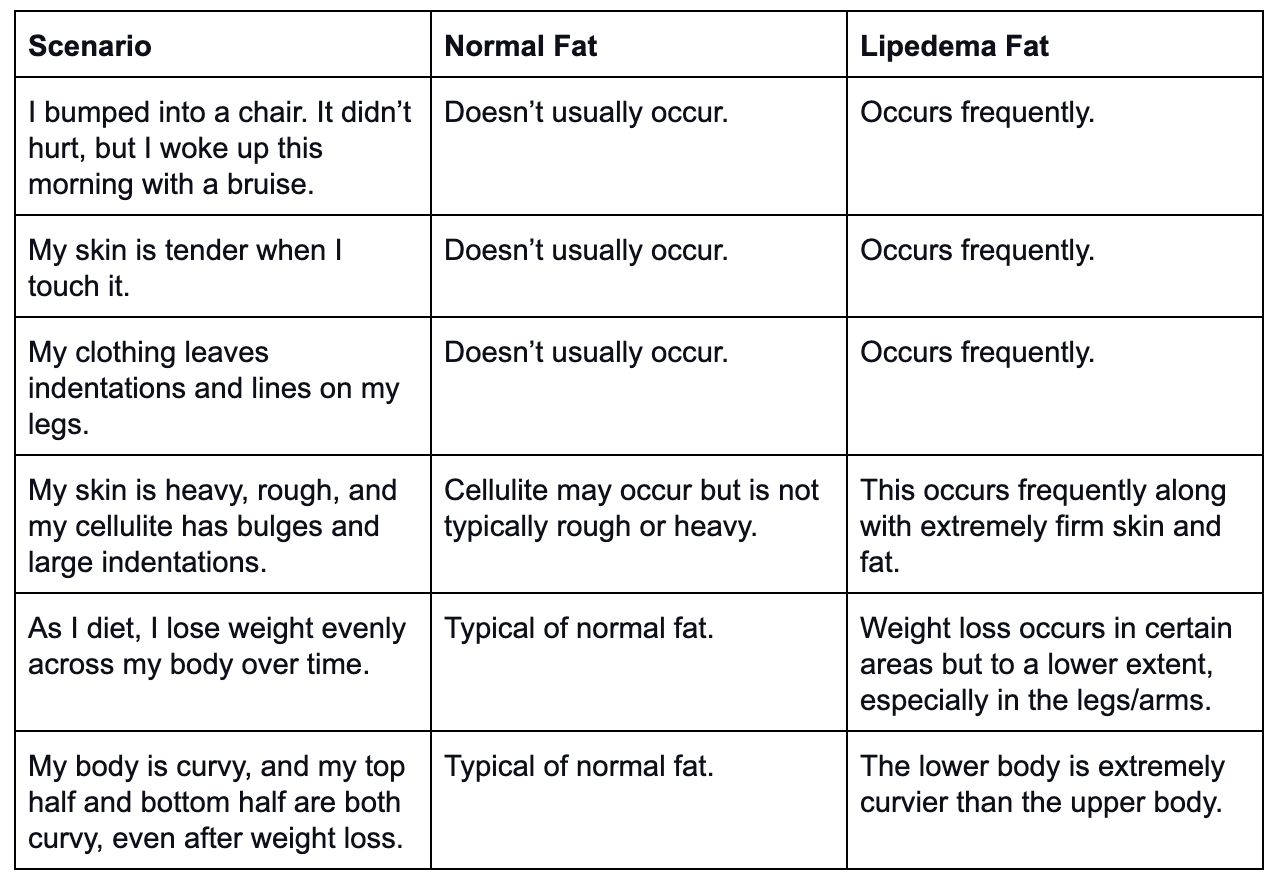
In improver to the differences in physical appearance, women with Lipedema as well commonly feel a range of painful symptoms. Do y'all trample hands in the affected areas? For example, many patients study that they'll get bruises from lightly bumping a chair, or may not know where their injuries came from at all. Additionally, exercise you feel pain from calorie-free touches to the affected areas? If your family pet jumps on you, or if your kid grabs your leg, would this cause you pain? Typically, this bruising and sensitivity lead to an inability to remain physically active, further increasing weight gain.
Normal Fatty vs. Lipedema Fatty
How practise you make up one's mind what's normal fat vs.Lipedema fat, and what's a normal sensation versus an abnormality caused past Lipedema? This part can exist difficult to determine, especially because many side furnishings aren't detected until the later on stages of Lipedema. And then how can we catch this as early as possible? The table below offers a comparison of what's widely experienced by women with Lipedema vs. what nosotros usually see in normal fat or obesity.
Getting Real Answers
Getting a proper diagnosis is both time-consuming and challenging. The lack of awareness both in the medical community and in club as a whole makes it difficult to know when information technology's appropriate to seek medical attention. Fifty-fifty then, because of the lack of awareness, your doctor may non recognize the symptoms as Lipedema. They may not be aware of the disorder at all. To add together insult to injury, if they practise realize information technology, they may non be trained on how to diagnose it or what the adjacent steps should be. Information technology'south important to advocate for your health, know the signs and symptoms, and seek out expert guidance.
This affliction is a subcutaneous fat storage disorder that is not widely recognized by the medical customs (yet). This disorder mainly affects women, causes an enlargement of the legs due to deposits of fatty under the peel, and typically gets worse over time, making diagnosis and handling essential.
While there may be a genetic component to Lipedema, the exact cause is not yet known. And while other fat disorders can crusade many of the symptoms mentioned hither (such as Dercum's and Madelung's disease), the majority of the time, the result is almost always a Lipedema diagnosis. Today, we know that Lipedema leads to an excessive build-up of fat cells, primarily in the lower body (although it tin touch the arms and abdomen), and it unduly creates pockets of fatty. The negative appearance of these cells is compounded by the physical hurting and sensitivity that comes along with it. While patients are frustrated and discouraged by the negative appearance of their legs, chronic hurting is what drives them to continue seeking answers.
Sufferers feel easy bruising and tenderness, and pain in the affected areas. Patients overwhelmingly report being misdiagnosed by their families and doctors every bit existence obese. Unfortunately, Lipedema fat is far more stubborn than regular fat, and will not respond to diet or exercise.
Those with this disorder may workout regularly and practice good for you and balanced nutrition but will continue to proceeds weight. Or worse, they experience weight loss as the normal fat is lost, yet the painful, Lipedema fatty remains. Normally, the lack of effectiveness from a regular diet and exercise programme is what prompts patients to recognize something isn't correct in their bodies. Even still, patients are oft at odds with their doctors and are provided with solutions that practise not accost their underlying condition, ongoing pain, and consequent frustration. Unfortunately, information technology'southward not uncommon for individuals with Lipedema to have more awareness of the disease and its treatment than the doctors and nurses who they encounter in their search for diagnosis and handling.
Weight Loss and Lipedema
 To further explore this frustrating aspect of Lipedema, a Washington Academy Schoolhouse of Medicine study evaluated the effect of diet-induced weight loss on body composition on both unremarkably overweight patients and those who were overweight due to Lipedema. All participants were first properly diagnosed with Lipedema on their legs past ruling out other causes of leg swelling, such as venous insufficiency. The written report subjects received both a body composition scan with DEXA [Dual Absorption Xray] and an MRI to ensure an accurate baseline trunk limerick evaluation. Each participant met with dietitians to create personalized salubrious meal plans designed to achieve an 8-10% weight loss goal over the course of half dozen-8 months. All meals were prepared in the medical school metabolic kitchen and calories accurately counted. Later on, weight loss was achieved, each patient received the same body browse and MRI to decide how their torso limerick responded.
Each participant's repast programme reduced their daily calories by 25% and included gluten, dairy, and egg-gratuitous meals as needed. They met with their dietitian weekly to record progress and choice-upwardly food for the following calendar week. The control group in this study went through the aforementioned procedure, however, they were diagnosed as obese and non with Lipedema, notwithstanding their BMI and historic period mirrored those in the Lipedema group.
For those of united states of america struggling with Lipedema, the results of the study come to no surprise. While the grouping who had Lipedema was able to lose weight and subtract their torso fat percentage, their relative distribution of their torso fat in the legs and trunk did not change. So, while they did lose weight, their legs remained disproportionately larger. Those with classic obesity experienced higher weight loss, a greater subtract in their percent of trunk fatty, and significant weight loss in their legs. Please note these ten% weight loss results are hard to translate into the real globe. Unfortunately, in the real globe, we don't take the luxury of someone preparing all of the meals, counting calories, and coaching u.s. weekly or more if needed forth the style.

And so Now What? Life Later a Lipedema Diagnosis & Treatment
If you remember you might have Lipedema, the first footstep is to run into a doctor for a diagnosis. Y'all can read more near the physical examination and necessary tests to make up one's mind if your provider can assistance you through this here. An ongoing treatment program should exist discussed with a medical professional, simply you can read more nigh surgical options hither, and non-surgical means to alive with Lipedema hither. While there's no cure for this disorder, a diagnosis is the start step to ameliorate agreement your body and, about importantly, that this is not your fault. The answer to your question, "Why are my legs so unlike?" is non that it runs in the family or that you aren't doing your best. The reply is that you have Lipedema, and we're here to assistance you through information technology.
Source: https://www.lipedema.net/am-i-overweight-or-do-i-have-lipedema.html
0 Response to "How Do You Know if You Have Lipedema"
Post a Comment